

Seafood restaurants are thin on the ground in this meat-obsessed region, so the long existence of Tre Cristi (it’s been around since 1830) should be heartily celebrated. The menu here is as elegant as the decor, and touches such as a complimentary glass of prosecco at the start of the meal add to the experience. Exemplary service.
Archives: Experiences
The Piccolomini Library
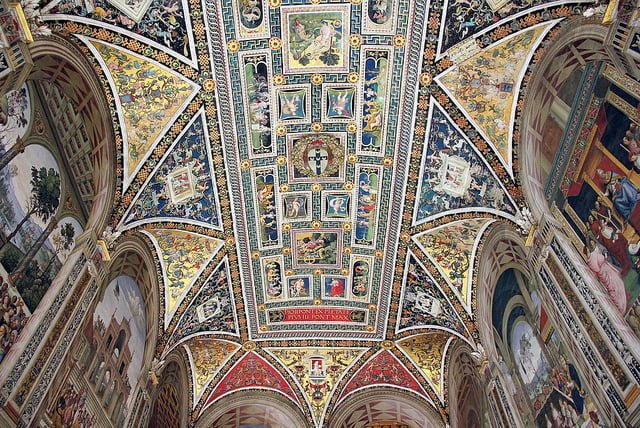
The Piccolomini Library was painted by the Perugian painter Pintoricchio (Bernardino di Betto) in 1502 for his patron, the cardinal of Siena, who wished to honour his uncle Pope Pius II who died in 1464. (The unfortunate cardinal Francesco eventually got promoted to the Papacy and died 10 days later!) Pope Enea Silvio Piccolomini was one of the greatest humanist scholars and the library in Siena was built to house his precious collection of illuminated manuscripts. The frescoes in the large lunettes that line the walls tell the story of the Pope’s life, while the surrounding decorative elements and ceiling are in the “grotesque” style that imitates ancient Roman examples that were very popular with artists and humanists at the time.
When you visit the Piccolomini Library, don’t try to understand exactly what’s going on in the frescoes, because it’s part of a secular story that you’re unlikely to know. What you do need to know is that it depicts a mythologized and glorified version of the life of the Pope, so look for the same guy in each scene. It starts at the far end on the right wall with a young boy, and you see this character growing older and always further up in the ecclesiastical ranks as you continue your way through the paintings. I heard a talk by an acquaintance about the role of gesture in this fresco cycle, from which I learned that there is often a figure helping us by pointing to the action; the gesture or hand motions of the protagonist are also important in communicating the moment of the story, such as acceptance of an honour or the giving of orders.
Mangia Tower

Dominating piazza del Campo, in the heart of Siena, the Mangia Tower stands tall, one of the most famous in Tuscany and, with its 87 metres in height (102 if you include the lightening rod), the third tallest historic tower in Italy.
It’s the civic tower for the Palazzo Pubblico, the city’s town hall, and its height was meant to symbolize the free communes and the liberation from feudal power.
The symbol of Siena was built between 1338 and 1348, constructed in brick with a stone cornice and belfry, boasting a light and elegant structure that takes its name from its first bell ringer. Giovanni di Balduccio was famous because he wasted his money, especially on good food, and was nicknamed Mangiaguadagni, literally Earnings Eater, abbreviated to Mangia: his role didn’t last long because in 1360, the first mechanic clock was installed, but the nickname was forever associated with the tower.
The top part of the tower, built in travertine, is the work of the Sienese sculptor Agostino di Giovanni, on the design by Lippo Memmi. In 1666, after various fusion attempts, a large bell was installed, which the Sienesi called Campanone, also known as Sunto because it was dedicated to the Mary Assunta.
Siena Cathedral

The exterior of the cathedral is pretty impressive, and if you don’t have a lot of time in Siena, you might not even go inside and just enjoy the outside. Built between 1215 and 1263 on the site of an earlier structure, the cathedral is in the form of a Latin cross with a slight projecting dome and bell tower. The exterior and interiors are decorated in white and greenish-black marble in alternating stripes, black and white being the symbolic colors of Siena.
If you have time to visit the cathedral, you might be tempted to skip it once you realize you have to pay to get in… but it is certainly worth it and, with the pass, it’s actually a great value! The pass gets you into the cathedral as well as the baptistery, crypt and Opera museum and is valid for 3 days so it most definitely worth the 10 euros!
If you’re visiting Siena after having visited Florence and its cathedral, you’re in for a shock! While Florence’s cathedral is immense and its cupola impressive, its interior is pretty spartan in comparison. In Siena, on the other hand, you don’t know where to look. The columns continue the white/black marble striped motif and, if you look up, there are busts of past religious men of Siena looking down upon you. I recommend you take a special look at the pavement: the most impressive and beautiful of the treasures the cathedral holds are on the floor, where the pavement is decorated with the art of mosaics (using various techniques) to create storytelling masterpieces.
The 56 etched and inlaid marble panels were designed by 40 of leading artists between 1369 and 1547, all from Siena except for Bernardino di Betto, known as Pinturicchio who was Umbrian. Completion of the designs took six centuries, the last ones finished in the 1800s. Today, the mosaic panels in the nave and aisles are usually uncovered although protected from passing feet by barriers, but the most precious ones are under the apse and in the transepts and these are generally protected by special flooring since this is where people sit for mass; these are only uncovered in honor of the Palio and a pair of months during the year, often in September and October.
Piazza del Campo

A universal symbol of the city, the distinct formation of the Piazza del Campo is just one of the reasons why UNESCO recognizes Siena as the ideal embodiment of a medieval city. Built in the exact place where the three antique hilltop towns sloped together, before eventually combining to create the community of Siena.
The main square, commonly called “il Campo” was built on the intersection of the three main roads that lead to and from Siena, destined to be a neutral ground where political and civic holidays could be celebrated. The homogenous architectural form of the square and the buildings facing it was not an accidental happening; the government created guidelines in 1297, before the actual building of the square and civic buildings. If any structure didn’t adhere, then they were torn down – as was the antique church for St. Peter and Paul. This signifies that it was always the city leader’s intention to create a harmonious structure between the buildings and the square.
The square, with a circumference of 333 meters, is paved with a fishtail design of red brick divided by 10 lines of white travertine stone creating a shell like appearance with 9 sections pointing directly to Palazzo Pubblico, the civic headquarters. Each section representing one of the ruling 9 governors in the “governo dei nove” and long considered to be one of the most stable and peaceful governments in Italy. Artistically speaking, the sections were to resemble the folds in the Virgin Mary’s cloak, who was not only the patron saint, but considered the “ultimate ruler” of Siena. Though some have suggested that the harmonic construction of the square is an artistic representation of the valley of Montone.
Lucca Comics & Games

Dylan Dog, represented by its publishing house, Sergio Bonelli Editore, is a constant presence at Lucca Comics & Game International Convention and just an example of what you will find by taking part in one of the most important Italian and European events dedicated to comics, cartoons, games, video games and so on.
Lucca Comics & Games has been taking place in the wonderful city of Lucca for many years now: since 1996 to be precise, but really since 1966 if we consider the original edition was named as Il Salone Internazionale dei Comics, the International Comics Salon, which is always held the last weekend of October.
The event is divided into the exposition area, where you’ll find hundreds and hundreds of stands, and the area dedicated to exhibitions, shows, games, and reenactments of historical games which is actually spread out over the city.
From a technical point of view, the convention is divided into Lucca Comics and Lucca Games, the first one being dedicated to comics and animations, and the second to games, from role playing to board games, from medieval games represented in historical settings created for the occasion and… the list goes on and on! Both sections have several areas at their disposal in the very heart of the city, although the Citadel is an area completely reserved to hosting games, exhibitions and contests in an area all over and under the ancient walls of the city, thus offering an incredibly suggestive setting: bastions, fortifications and underground itineraries that were once home, in fact, to the ancient city prisons.
The Palazzo Mansi National Museum

Mansi Palace is located in the city center of Lucca and dates from the late sixteenth century and was acquired in 1616 by the Family Mansi who performed an internal restructuring in the Baroque style in contrast to the austerity of the exterior features. The two wings at right angles to the central nucleus dates back to the nineteenth century, with a single ramp staircase leading to the first floor in a gallery overlooking the garden.
The museum has been located in this luxury building in 1965 when it became the property of the State and was completely renovated. In 1977 was inaugurated the National Art Gallery. Were later recovered the original furnishings, frescoes and tapestries on the walls. Interesting are the frescoes on the ceilings of a boardroom. Of note, the Bridal Chamber with the original alcove and fabrics of silk embroidered 700.
The Incorruptible St. Zita

Zita is one of the “Incorruptibles” — bodies of Catholic saints that were found to miraculously not deteriorate.
She began her life as a peasant girl who went to work as a servant in Lucca at age of 12, and was known for her sunny demeanor, work ethic, and for giving leftover bread to the poor. After many years of working as a domestic, she was promoted to head housekeeper, and a series of miracles began to reward her hard work and piety. The story most often related concerns her distribution of bread to the poor. One day, as she was smuggling bread from the home of the family she worked for, a fellow servant ratted her out. When the head of the family pulled open her apron, instead of bread, only flowers fell to the ground. According to legend, when she died at age 60, the church bells spontaneously began to toll.
In 1580, her body was exhumed and found to be incorruptible, and her body was put on display in a silver casket, as is tradition, in the church where she had prayed while alive. She was finally canonized in 1696. Although her body is “incorruptible,” it is browned and wizened, most likely the result of a form of natural mummification. Only her hands and face are uncovered for viewing.
In 1988, her body was examined by Gino Fornaciari of the University of Pisa. His studies concluded that she had died of lung problems, probably associated with inhaling coal dust and smoke.
Every year on April 27, citizens of Lucca bake bread and bring flowers (often daffodils) to San Frediano in celebration of her feast day, and the saint is brought out to be touched by the pious. Her body is on display in a chapel on the inside right hand side of the church.
Piazza dell’Anfiteatro

The Piazza dell’Anfiteatro in Lucca is today a bustling plaza where tourists can enjoy their food and drinks, but several centuries ago, it was in this very spot that gladiators battled for supremacy in front of rapt audiences.
Situated on the northeastern side of the ancient walled Italian city, the marketplace is surrounded by buildings constructed exactly on the lines of an old Roman amphitheater, using parts of the original structure, giving it a distinctive elliptical form and its name. The best way to see the plaza’s shape is from above but the view from inside the buildings also offers a different perspective of the plaza.
The construction of the amphitheater began in the first century but it wasn’t completed until much later with the financial help of a wealthy resident. The theater’s 18 rows could seat nearly 10,000 viewers, making it an important site of entertainment and games of strength.
During the Gothic Wars of the sixth century, the site, along with many parts of the city, was fortified, and later houses and even a prisons were built on the crumbling ruins of the theater. The plaza took on its current form between 1830 and 1839, when architect Lorenzo Nottolini demolished some of the buildings crowding the inside of the arena, and restored its structure by using the original elliptical plan. The base of the amphitheater is now buried about nine feet below the center, and the remaining vaults and arches have been incorporated into the modern shops, cafes, and houses that circle the plaza.
The Piazza, which is also called Piazza Del Mercado, can be reached via four gateways, each at the four extremes of the ellipse. A recent addition to the plaza, a massive bronze sculpture of a human head by Polish artist Igor Mitoraj, is fast becoming one of the most popular selfie backgrounds in Lucca.
Gustevole

With enticing flavours like liquorice and mint, ricotta with fig and walnut, or pine kernel made with local Pisan kernels (nuts in sweet, crunchy caramelised clumps), the most recent addition to Lucca’s artisan gelato scene is pure gold. Gelato is organic, natural and gluten-free. The key to entering gelato heaven: ask for a dollop of thick whipped cream on top.