Lucca Cathedral

Lucca Cathedral is a place of legend and emotion. It’s the jealous guardian of the Volto Santo, or Holy Countenance. It’s also houses the tomb of Ilaria del Carretto, one of the finest works of 15th century Italian sculpture.

The Romanesque exterior, with its elegant portico, arcades and beautifully decorated doors, warrants a good look before you even step inside the church. Notice the vividly expressive equestrian sculpture (circa 1240) dedicated to the episode that changed the life of San Martino.

Under the same arcade is a labyrinth carved in stone; a figure much-loved by mystery seekers that represents a journey of spiritual awakening and, for the more religious, salvation through faith. On the right hand side a latin inscription reads: “This is the labyrinth built by Dedalus of Crete, from which none could escape except Theseus helped by Ariadne’s thread.”

Torre Guinigi (Guinigi Tower)

Built of red brick and topped by several ancient Holm oaks, the 125 foot high Guinigi tower house is one of the few remaining tower houses in Lucca. It was built in or around 1384 by wealthy silk merchants, and, although no one know exactly how old the rooftop garden is, it dates back to at least 1600 when it appears in a contemporary drawing of the city.

Once bristling with as many as 250 defensive tower houses, today, only about 9 remain in the ancient walled city . The towers were built during the mercenary-filled post-plague years in Italy, when Tuscany was repeatedly turned upside-down by disease, raids, and outbursts of politically charged violence. The 14th century in Italy was, as they say, Interesting Times. It made sense to have a personal defensive tower.

The center of Lucca dates back to Roman times, but it found its stride during the middle ages as a crossroads of trade and a center of the silk trade. Independent since 1119, in 1314 Lucca was raided and fell under the power of a local born condottirere, or mercenary, Castruccio Castracani. Ambitious and ruthless, Castracani set his sights on conquering more land including nearby Florence, and spent the remainder of his rule making war on the neighbors (his life story was documented in detail by Machiavelli).

Following his death, rule of the town fell to the Guinigi family. As in nearby Pisa, Sienna, and Florence, the wealthy landowners began building a tower onto their palace home, both as an overt manifestation of their wealth and power, but also as a defensive position and lookout when things got rough. Throughout Tuscany, the shape of crenellations on the top story often indicated the loyalty of the owner. The tower building mania became enough of an issue that many Tuscan towns established building limits on height and style of the towers. In battles, destruction of the towers – often specifically targeted properties of certain families – was common, and a blow to the pride of the victimized town thereafter.

Napoleon raided Tuscany in 1805, annexed it to France, and gave Lucca to his sister Elisa in 1809. She held on to her title of Grand Duchess of Tuscany until 1 February 1814. She can be credited with the beautifully maintained outer walls and the trees planted along them.

Restored and reopened in the 1980s, today the tower’s rooftop garden is accessible via a climb of 230 stairs (a modern addition – the original stairs were on the outside). From the rooftop you can see the outlines of the three concentric city walls, the Roman center of town, and the few remaining other towers. Across town, the Torre della Ore (clock tower) is also open for climbing.

Loggia dei Lanzi

To walk around the city of Florence means encountering works of art everywhere you go: palaces, churches and statues await visitors around every corner! The city itself is an open-air museum! But if there is one place where this definition takes on its full meaning, it is the Loggia della Signoria. Or Loggia dei Lanzi. Or Loggia dell’Orcagna! Whatever its name, the loggia is a unique example of an open-air sculpture gallery containing antique and Renaissance art and one of Florence’s landmarks (and it’s free!).

It consists of wide arches open to the street and the name Loggia della Signoria comes from its location along one side of Piazza Signoria, adjoining the Uffizi Gallery. The name Loggia dei Lanzi has been used since the mid-sixteenth century, when the place was used by Grand Duke Cosimo I to house the German mercenary pikemen, known as “Lanzichenecchi”. The name Loggia dell’Orcagna, on the other hand, is due to an incorrect attribution of a project. It was built between 1376 and 1382 by Benci di Cione and Simone di Francesco Talenti, possibly according to a design by Jacopo di Sione, to house the assemblies of the people and to hold public ceremonies of the Florentine Republic. Since the sixteenth century, with the creation of the Grand Duchy of Tuscany, the Loggia became an expression of Medici power and was intended to accommodate some sculptural masterpieces, becoming one of the first open-air exhibition areas in the world. Note that the sculptures were not positioned according to merely aesthetic criteria but to affirm and represent specific political meanings. After the construction of the Uffizi, Buontalenti created a roof garden above the arches of the Loggia and the roof became a terrace from which the Medici could watch ceremonies in the piazza (today, it is one of the most spectacular terraces in Florence, attached to the Uffizi Museum, and it houses the museum’s bar and various events). After admiring the Loggia from the square, go up the stairs passing between the two huge Medici lions, symbolic of Florence: the one on the right dates from Roman times, the one on the left was sculpted by Flaminio Vacca in 1598 and was originally placed in the Villa Medici in Rome and in the Loggia in 1789. Take the time to admire the statues up close and from all sides. A little tip: visit the Loggia at night (yes, it’s always open!), when the number of tourists decreases dramatically and the statues stand out against the dark sky.

Piazzale Michelangelo

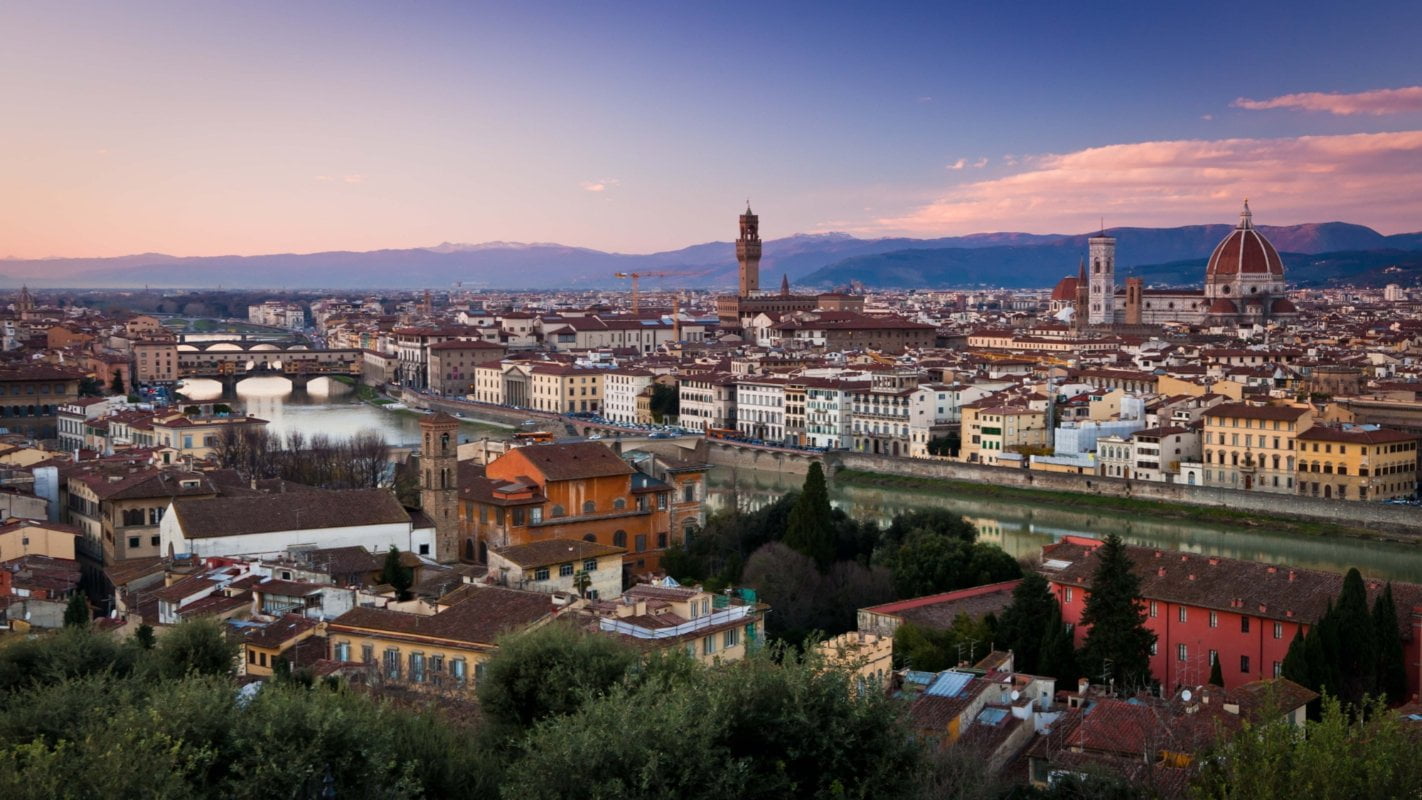
Piazzale Michelangelo is one of the best and most famous lookouts for a stunning view of Florence, day or night, and best of all it is free! It just takes a little legwork and there are a few easy ways to get there.

One is a lovely walk along the south side of the river upstream towards the Torre San Niccolò, an old tower of the now destroyed medieval city walls which you can see jutting out over the rooftops from afar. Here, you are directly underneath the piazza, simply follow the looping ramps up to the top of the hill. Another nice walk is from the Porta San Miniato gateway, accessible from Via San Niccolò. Go through the gateway and up a short but steep street; in front of you is the “shortcut,” picturesque stone steps that will lead you straight up to the piazza in a matter of minutes. You will pass by the entrance to the lovely rose garden on the way up. Don’t forget to take a peek behind you to catch the growing panorama of Florence.

The other way up to the piazza, for those who are saving their energy, is to take the local bus number 12 or 13. Find them at the train station, near the taxi stand, either one will take you all the way up to Piazza Michelangelo for the cost of €1.20 a single ride (tickets must be purchased in advance at a tabaccheria, tobacconist).

From the piazza, a five minute stroll up past the church of San Salvatore will take you to the unique and beautiful monastery of San Miniato al Monte. With absolutely the best view of the city, San Miniato al Monte is a stunning example of original Tuscan Romanesque architecture dating from 1013. The monks still make honey, tisanes and liqueurs to sell to visitors and it is also possible to visit the church while the monks sing Gregorian chant at 5.30pm.

In the grounds surrounding the church there is a beautiful monumental cemetery laid out in the mid-1800’s and protected by the old defensive walls of the church designed by Michelangelo during the Siege of Florence in 1529-30.

A wonderful panoramic walk from San Miniato back to the centre of Florence can be enjoyed by turning left (with the church behind you) onto Viale Galileo, the tree lined boulevard. As the road winds along and you enjoy the shade of the trees there are the most splendid views of Florence until you reach Via di San Leonardo on your right. Taking this charming narrow street, look for the plaque on the wall of the first villa on your left that says Tchaikovsky lived here in 1878. Continuing along past beautiful villas and the tiny eleventh century church of San Leonardo in Arcetri you will come to the Forte Belvedere and the 13th century Porta San Giorgio. Here you can either go through the arch of the old city gate and straight down the hill to arrive at the Ponte Vecchio, or you can follow the old city wall to the right and back to the area of San Niccolò, below the Piazzale Michelangelo.

Le Volpi e l’Uva

Le Volpi e l’Uva was opened in 1992 by Emilio Monechi, Riccardo Comparini, and Ciro Beligni with the intention of cultivating relationships with small wine producers and creating a locale where wine is accessible to all.  25 years ago this approach was an entirely new way of buying, selling, and presenting wine in Florence.

Throughout the years, Le Volpi e l’Uva have continued to search every region of Italy for wines, paying extra attention to the unique terroir of individual areas and appellations, highlighting wines made with native grapes, and featuring wines made using organic and biodynamic agriculture. Le Volpi e l’Uva believe in the importance of buying directly from the winemakers, as well as taking time to visit these producers and understand the philosophy behind each wine.

Officina Profumo-Farmaceutica di Santa Maria Novella

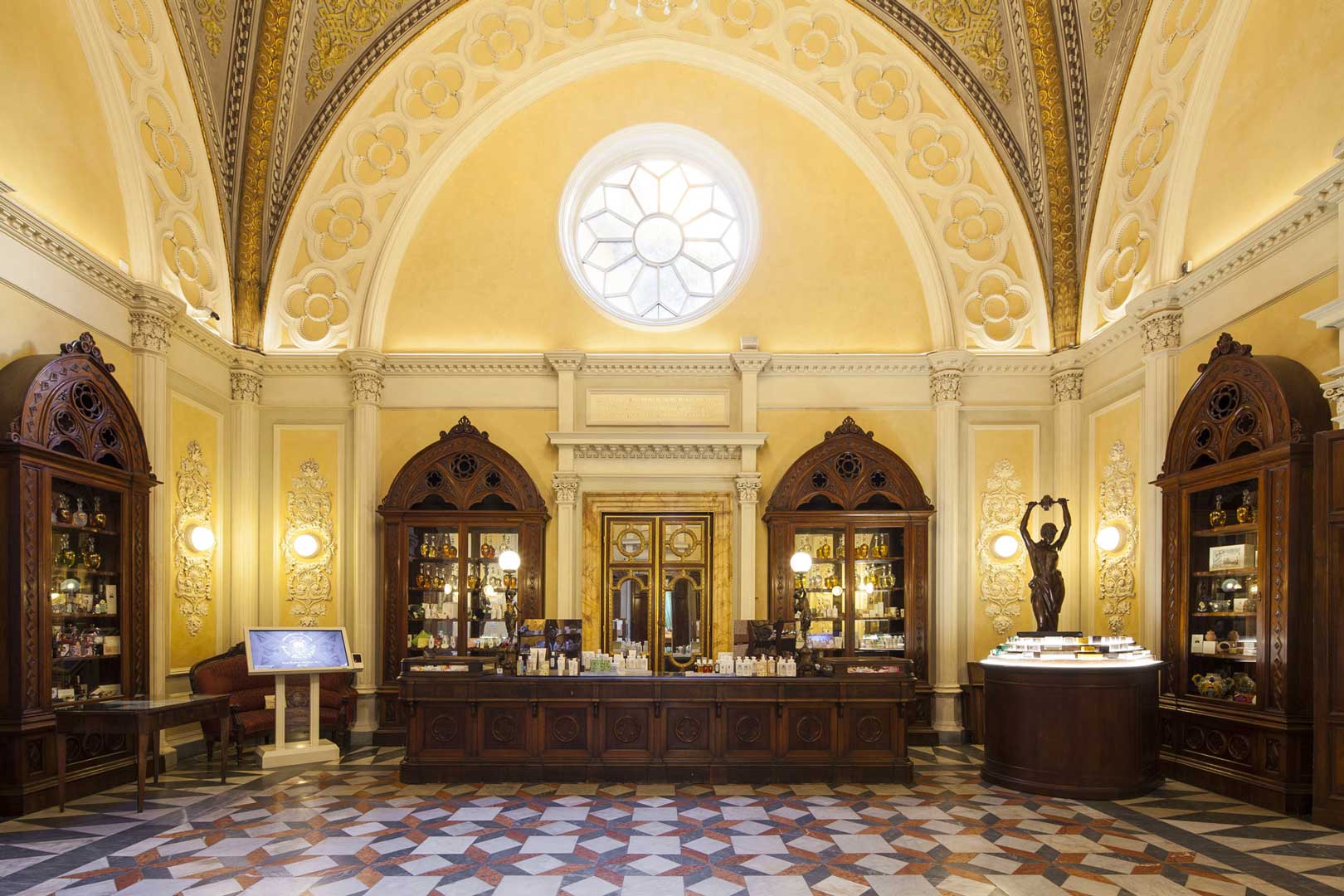
In business since 1612, this exquisite perfumery-pharmacy began life when Santa Maria Novella’s Dominican friars began to concoct cures and sweet-smelling unguents using medicinal herbs cultivated in the monastery garden. The shop, with an interior from 1848, sells fragrances, skincare products, ancient herbal remedies and preparations for everything from relief of heavy legs to improving skin elasticity, memory and mental energy.

It also sells teas, herbal infusions, liqueurs and scented candles. A real treasure, the shop has touchscreen catalogues and a state-of-the-art payment system, yet still manages to ooze vintage charm. After a day battling crowds at the Uffizi or Accademia, you might just want to come here for a cup of carefully prepared tea in its Tisaneria (Tearoom) or to buy a bottle of Aqua di Santa Maria Novella, one of the pharmacy’s oldest herbal concoctions, taken to cure hysterics since 1614.

Essenziale Restaurant

Essenziale is a project started in September 2016 serving Italian cuisine that enjoys to be contained from the rest of the world. Service is taken care of by only one waiter, that takes orders and serve the wine, while all the rest is done by our cooks, that serve and explain the dishes they prepare. Open for dinner from Tuesday to Sunday.

There’s no finer showcase for modern Tuscan cuisine than this loft-style restaurant in a 19th-century warehouse. Preparing dishes at the kitchen bar, in rolled-up shirt sleeves and navy butcher’s apron, is dazzling young chef Simone Cipriani. Order one of his tasting menus to sample the full range of his inventive, thoroughly modern cuisine inspired by classic Tuscan dishes.

If you’re lucky, it will be the chef himself who brings the dish to your table and treats you to a detailed explanation: don’t miss the tale behind his remarkable Fior d’Evo dessert, notably with kale (another of his desserts includes artichokes). Sunday ushers in brunch, a fabulously revolutionary affair with a choice of three courses, unlimited coffee and water, and most likely the most remarkable French toast, waffles and eggs (with purple cabbage) you’ve ever tasted. Reservations essential.

Uffizi Gallery

The “Galleria degli Uffizi” is one of the most famous museums in the world given the rich amount of unique artworks and masterpieces conserved within its walls, the majority from the Renaissance period. The main part of the collections were left by the Medici to the state of Tuscany so that they could “adorn the State, be of utility to the Public and attract the curiosity of Foreigners”.

Located in the heart of Florence, the Uffizi Gallery hosts works of art by great Italian artists such as Botticelli, Giotto, Cimabue, Michelangelo, Leonardo da Vinci and Raffaello, just to name a few of the most famous. Its large collection has works from all centuries but a large part dates back to the periods between the 12th and 17th centuries.

The Uffizi Gallery is a must-see destination for anyone visiting Florence and Tuscany and welcomes over a million visitors each year. The Uffizi, together with the Vatican Museums in Rome, are the top two most visited museums in Italy by visitors from all across the world and the long lines at the museum’s entrance are almost as famous as its masterpieces!

Piazza della Signoria

The Piazza della Signoria has been the center of political life in Florence since the 14th century with the prominent Palazzo Vecchio overlooking the square. It was the scene of great triumphs, such as the return of the Medici in 1530 as well as the Bonfire of the Vanities instigated by Savonarola, who was then himself burned at the stake here in 1498 after he was denounced by the Inquisition as a heretic. A marble circle inscription on the piazza shows the location where he was burned.

The sculptures in Piazza della Signoria bristle with political connotations, many of which are fiercely contradictory. The David (the original is in the Galleria dell’Accademia) by Michelangelo was placed outside the Palazzo Vecchio as a symbol of the Republic’s defiance of the tyrannical Medici.

Bandinelli’s Hercules and Cacus (1534) to the right of the David was appropriated by the Medici to show their physical power after their return from exile. The Nettuno (1575) by Ammannati celebrates the Medici’s maritime ambitions and Giambologna’s equestrian statue of Duke Cosimo I (1595) is an elegant portrait of the man who brought all of Tuscany under Medici military rule.

Florence Cathedral

Florence Cathedral is the heart of the city, both geographically and emotionally. It’s the pride of Florence, and one the most impressive churches in the world.  If you only have an hour to visit, spend it in Piazza Duomo and the surrounding streets. If you have more time, climb the dome for a breathtaking view of the city.

Florence Cathedral has been a symbol of grandeur since the time of its construction. Easily the largest church of its time, it was intended as a way to publicise the city’s wealth and power, and stand out from the cathedrals of rival cities Siena and Pisa.

This phenomenal church can seem almost too big. It towers above the narrow streets of the city centre, and is clearly visible from every direction, including the surrounding hills.

From up-close the cathedral of Florence is a feast for the eyes. It has three apses, crowned by miniature copies of the major dome and is flanked by the magnificent Gothic bell tower by Giotto. The marble facade is more recent. It was only finished in the 19th century, a stunning example of the Neo-Gothic style.